
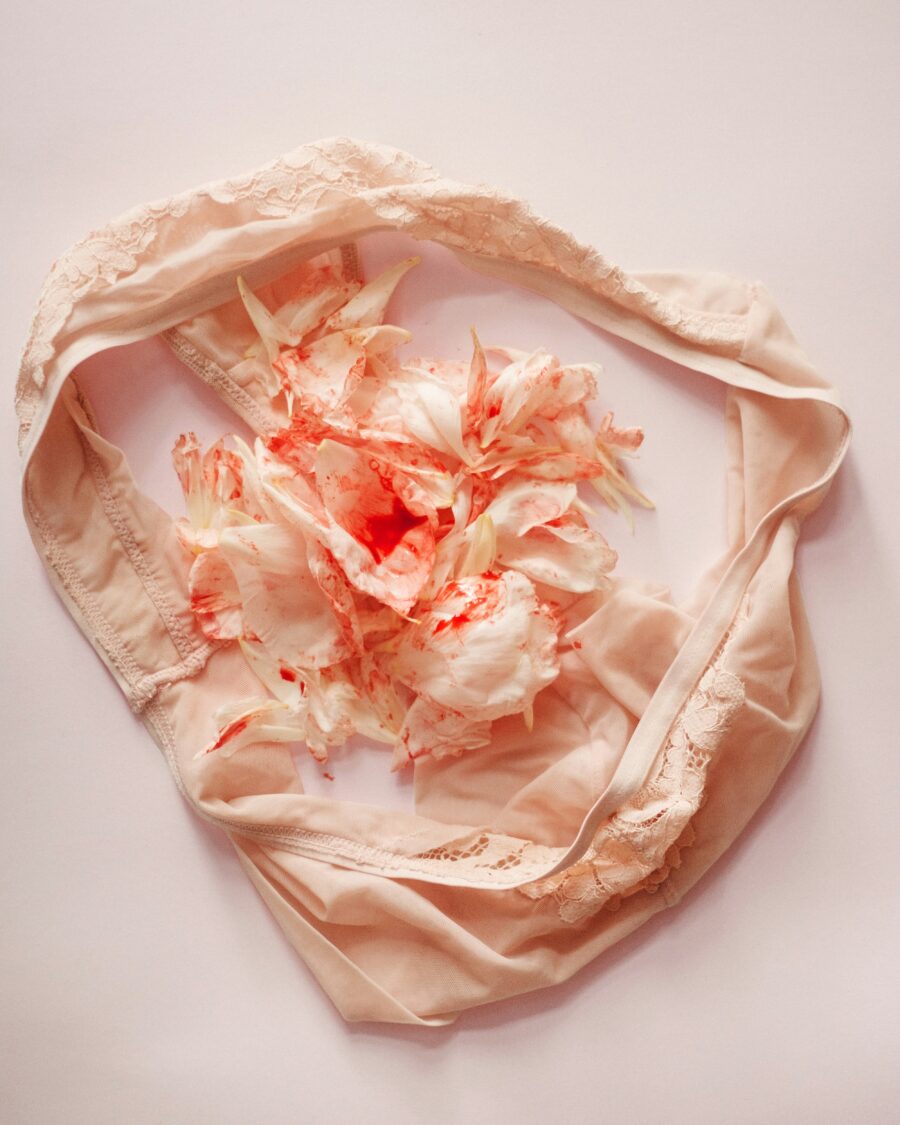
Photo by Monika Kozub on Unsplash
Although humans are one of the only species among mammals that menstruate, critical menstruation studies and vegan feminist studies alike have failed to examine intersections of species and sex in the context of period politics. There are a number of entanglements that would suggest the utility of advancing multispecies critical menstruation studies. Women, for one, have historically been animalized, and menstruation is often identified as a marker of women’s other-than-human status. Menstruation draws attention to the body, to base reproduction, to bleeding, to morality, to the ultimate animal being of humanity. It also serves as a powerful form of distinction that patriarchy has wielded in the disempowerment of women as a class.
Period shame has been one significant consequence for women and other menstruators, and a cultural silence on menstruation has manifested that persists even today in the 21st century. Bleeding, while a very prevalent experience for much of the population, is hidden away. This suppression, in turn, becomes vital in the maintenance of menstruating people’s diminished status.
Nonhuman Animals, meanwhile, are themselves deeply impacted by period culture. The disposable sanitary napkin and tampon industry, for instance, pollutes waterways and inundates landfills. Menopause supplements that are targeted at the pathologized post-menstrual woman, furthermore, are often loaded with ingredients extracted from or tested on exploited animals who suffer greatly. Finally, like menstruating people, the lived experiences of Nonhuman Animals are silenced, masked from everyday discourses to the effect of maintaining the anthropocentric systems that harm them. The currents of blood that pour into vivisection laboratories and slaughterhouses from billions of exsanguinated animals each year remain notably obfuscated. Bleeding, for menstruating people and animals alike, is hidden.
Feminists who have advocated period pride and a greater cultural acceptance of menstruation often do so by emphasizing women’s humanity and distinctiveness as a species. Indeed, menstruation can also be politicized to demonstrate women’s evolutionary superiority and their pivotal role in advancing human civilization. While this tactic is understandable given the longstanding systemic discrimination against animalized women, it is also the case that emphasizing women’s species superiority and distinction for other animals necessarily aggravates the lower and more vulnerable status of Nonhuman Animals.
Critical menstruation studies will need to overcome species stigma and engage with vegan studies that are better positioned to understand the politics of animality in the perpetuation of inequality. Likewise, vegan feminism, for its part, must overcome period shame and consider how bleeding is socially constructed in broader cultural contexts. My publication for the Journal of Feminist Theory takes a vegan feminist perspective and argues that destigmatizing and reclaiming animality will prove beneficial, even liberatory, for women and other menstruating people and Nonhuman Animals.

Readers can read the full article in the journal of Feminist Theory and can learn more about vegan feminist studies in my 2027 publication with Bloomsburys, Vegan Feminism.
Receive research updates straight to your inbox by subscribing to my newsletter.
