
On the spectactual Sellout of Veganuary and the Persistence of “Welfare” Narratives in a World in Desperate Need of Liberation
This Veganuary season has been an especially trying one here in the UK. First, television streams have been absolutely saturated with corporate-funded, government-backed countermovement advertisements, encouraging the consumption of bovine breastmilk and sheeps’ babies. These animal-free and somehow animal-full commercials are bedazzled in bright colors, upbeat music, and diverse young people jumping, savoring, delighting while various isolated nutrients are flashed across vibrant backgrounds. Veganism seems antiquated and out of touch by comparison.
Second, the Veganuary roll-out, once a cheeky “second Christmas” for British vegans who anxiously monitor vegan social media for sneak peeks of what new treats await them in January, has this year proven a complete and flabbergasting letdown. This overwhelming disappointment seems best exemplified by Subway’s pitiful falafel wrap offering, its once cutting-edge plant-based menu officially retired. The step back into time, will be unlikely to titillate any vegan or would-be-vegan, especially when fresh falafel is easily purchased in a variety of Middle Eastern eateries across the average high street. Subway will no doubt quickly remove this meagre offering after it predictably undersells.
This year’s lacklustre Veganuary, I think, indicates the strategic failure of capitalist collusion that has been promulgated by the professionalized Nonhuman Animal rights industry with gusto since the neoliberalization of social change beginning in the 1980s. It also indicates a fundamental misalignment between bottom-line, sales-oriented appeals to consumer culture and system-change-oriented efforts to revolutionize multispecies relations. However, alignment between strategy (capitalist consumer appeals) and goal (animal liberation) is actually not the issue here. This is because professionalized animal advocacy is masking another goal altogether, that being its aim of mastering neoliberal growth.
Was Veganuary ever about social change? Or was it conceptualized as an easily branded market strategy that delineates it in a crowded charity sector vying for corporate, state, and public funds? Whatever its original intention, it is clear that Veganuary’s aim of advancing veganism swiftly mutated into an aim of growing the organization—at the cost of veganism. It came as no surprise, then, when Head of Communications for Veganuary, Toni Vernelli, defected to join an even more moderated charity FarmKind in developing its “Forget Veganuary” campaign which encourages the consumption of fellow animals as a measure of compassion. In moderating to widen their constituency and potential donor base, these corporate “advocates” have essentially absorbed into the status quo, becoming agents of industry greenwashing initiatives.
Working with capitalism might not make sense for social justice efforts, but it does make sense for charities. The charity sector is the third biggest economy in the world. Bizarrely, then, welfare charities have every incentive to protect cruelty to protect their own revenue streams. They profit from human guilt. Guilt, in fact, becomes a commodifiable resource. In treating compassion as a commodity, these charities primarily advocate fundraising, with some toothless policymaking efforts kicked about from time to time that inevitably only benefit speciesist industries in maximising their efficacy and managing their public relations.
To maximize the funding base, anything-but-vegan charities dilute the message so far that it applies to everyone “as they are” without pushing any significant behavioral or attitudinal change beyond socializing the populace to equate donating to charity with the mitigation of society’s worst instances of suffering. The tired welfarist mantra that “meeting people where they are” is self-evidently less alienating to audiences and necessarily so. It is the falafel wrap of social change, an unassuming, approachable offering that masks a larger political structure in the maintenance and reproduction of a deeply unequal society that maximizes and protects wealth accumulation for the dominant class. It is a strategic distraction, redirecting attention from the underlying profit motivation and asset maximization that fundamentally drives anything-but-vegan campaigning.
Consider that, once people are met “where they are” with anything-but-vegan campaigning, when do these charities ever push for veganism? If ever? Their primary purpose is to repackage and greenlight oppressive behaviors. This strategy is a win for greenwashed and humane-washed industries, and it is a win for neoliberalized growth-oriented charities, but it is a grave loss for the trillions of nonhuman lives at stake, public health, and a disintegrating planet. Veganism not forthcoming, the public is thus indoctrinated with the antisocial toxic neoliberal wealth- and inequality-protecting ideology of the far right, decorated with never-ending appeals to “donate” to boost third sector coffers. The true function of the third sector, in fact, is to reproduce existing power relations by building wealth for privileged groups and massive corporations while disseminating the ideologies of the ruling class that ensure consumption and quell dissenting ideas.
When charities go pro , this is the deal they are making. It is systemic. It is a corrupting economic logic of growth. It is a customer is always right approach designed to placate the revenue pots. It is not a strategy for social change. A cursory glance at the job boards demonstrates this. Most available positions appeal to business school graduates specializing in strategies for accumulating wealth and liaising with important revenue sources. Completely absent are any calls for critical thinkers studied in the science of social movements, feminism, sociology, philosophy, or political science. Charities are looking for business brokers who are “growth oriented” and well networked with conservative funding institutions not scholars of liberation. Liberation, quite frankly, is bad for business.
Supporting the cause by surrendering a payment method is charity. Opening hearts, changing minds, and actively disengaging with the social harm in question is social change. Charities treat corporations and individual donors as customers who are peddled a veneer of ethical integrity. Ethics are for sale, and it’s a thriving industry.
Going vegan, however, does not cost a thing. In fact, a recent Oxford study finds that veganism is, on average, about a third cheaper. In the long run, it is immeasurably cheaper when considering costs to public and environmental health. Despite the corporate speak promulgated by these big charities, veganism is neither alien nor unobtainable. Plant-based diets have been affordably sustaining the global majority until only a few decades ago.
In any case, it is free to change our mind. It is free to care about the wellbeing of others and disentangle ourselves from their systemic oppression. Care need not be commodified. It is a common good that must be protected. Activists must resist the ideology of the ruling class as it manifests in the third sector to control the discourse and discourage radical resistance. Corporate charity interests are wedded to wealth accumulation and this banks on appeasing conservative funders and industry “collaborators”. Dissent against violence is a birthright, not a commodity to be extracted, denatured, and sold back to us. That 2026 is shaping up to be the “Year of the Old and Cold Falafel” is a bummer, but then again, Subway wraps were never going to save the world in the first place.
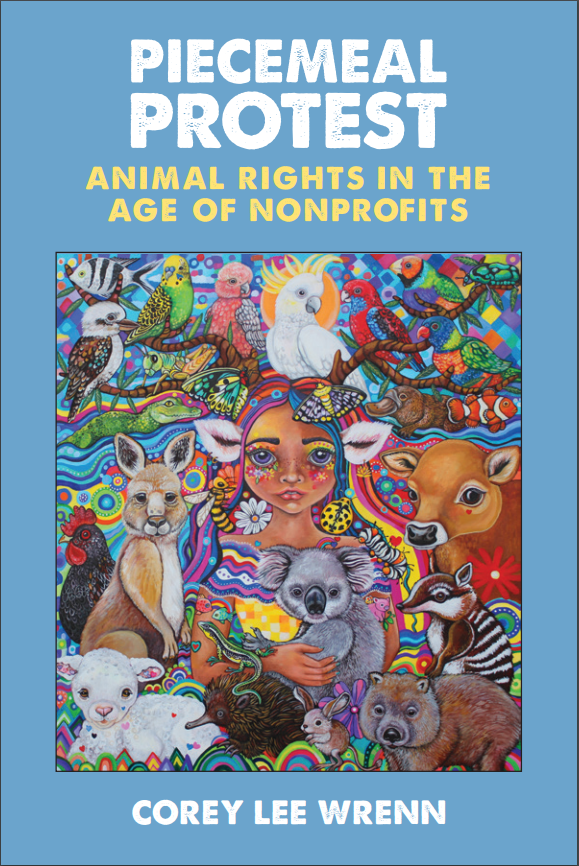
Readers can learn more about the social movement politics of Nonhuman Animal rights and veganism in my 2019 publication, Piecemeal Protest: Animal Rights in the Age of Nonprofits. The beautiful cover art for this text was created by vegan artist Lynda Bell and prints are available on her website, artbylyndabell.com.
Receive research updates straight to your inbox by subscribing to my newsletter.
